- Brochure WebsitesProfessional 5-10 page sites
- Web Design PackagesMonthly plans from £69
- Responsive DesignFluid layouts for every device
- E-Commerce DesignStorefronts built to convert
- Product PagesCatalogue & product listings
- Mobile DesignMobile-first experiences
- Landing PagesHigh-converting campaign pages
- Website Redesign
- Case StudiesReal client projects
- Retail & E-CommerceOnline stores & shop websites
- Professional ServicesLaw, finance & consulting
- Hospitality & LeisureHotels, leisure & food service
- Property & LettingsEstate agents & lettings portals
- Trade & ConstructionBuilders, plumbers & electricians
- Industrial & ManufacturingEngineering, logistics & manufacturing
- Web ApplicationsCustom business tools & portals
- E-Commerce DevMagento, Shopify & bespoke
- CMS DevelopmentCustom content management
- Database SystemsBespoke data solutions
- Mobile AppsiOS, Android & hybrid
- Sage 50 IntegrationAutomate your accounts
- SaaS PlatformsMulti-tenant applications
- API DevelopmentRESTful & GraphQL APIs
- Next.js & ReactModern frontend frameworks
- WordPressBuild, fix, host & look after
- Search Engine MarketingRank higher on Google
- Content WritingSEO-optimised copy
- ConsultingStrategic digital advice
- Logo DesignBrand identity creation
- Web HostingDedicated UK servers
- Email HostingProfessional mailboxes
- MaintenanceOngoing support & updates
- Security & SSLKeep your site safe
- Domain RegistrationFind your perfect domain
- Blog & InsightsTips, guides & news
- Free SEO AuditCheck your site health
- AI ChatbotsGPT-powered conversational AI
- AI Voice AgentsAnswer calls 24/7 automatically
- AI AutomationEliminate repetitive workflows
- Custom AI DevelopmentTrained on your business data
- AI IntegrationConnect AI to your existing stack
- AI ConsultingStrategy & honest AI advice
- GPT-4 & ClaudeLatest large language models
- ElevenLabs VoiceNatural-sounding voice AI
- RAG SystemsAI that searches your knowledge base
- CRM IntegrationHubSpot, Salesforce & Pipedrive
- Document IntelligenceExtract data from any document
- Private AI DeploymentYour data never leaves your servers
Case Study
Sign Company Website Design — PJ Signs Case Study
A Taunton sign maker of forty years — a site where the seven things they make slide past full-screen as you scroll, and a photograph of the shopfront is enough to start a price.

Forty years of signs in Taunton
PJ Signs have been making signs in Taunton since 1986. Shop fronts, sign trays, wayfinding and safety signs; vehicle wraps, fleet livery and chevron kits; large-format printing, banners and flags, pavement signs, laser engraving, labels and cut vinyl.
All of it is designed, made and fitted from the same unit. The person who draws your sign is the person who makes it and puts it up — no account managers and no handoffs — and that is the difference the site is built to carry. It is the reason somebody picks a forty-year-old local firm over a national print portal, and it was nowhere on the old website.
Their own words for it are on the page: design, manufacture and installation under one roof, from a single pavement sign to a whole shop front, or a fleet in matching livery.
Seven services, seven full screens
A sign company sells things you have to see. A list of seven links does not do that, and neither does a carousel that nobody clicks.
So the home page hands the middle of itself over to the work. Each of the seven services is a full-screen panel with the job photographed behind it, and scrolling down the page swipes them sideways one after another — general signage, vehicle graphics, digital printing, banners and flags, A-boards, engraving, labels and stickers — before the page releases and carries on down.
There are no arrows and nothing to click through: the only control is the scroll the visitor is already using. Each service also has its own page behind it, so the site can still rank for vehicle wraps and for laser engraving separately, which one home page never could.
What the old site was quietly losing
Before anything was designed, their live site was audited page by page. It was not a pretty reading.
Sixteen pages. One of them, banners and flags, had no title, no description, no heading and no words on it at all — a service they sell, published as an empty page. Six more pages had no H1 for Google to read, and four had seven or eight competing H1s, which is the same problem from the other end. There was no privacy policy, no cookie policy and no accessibility page: every one of those addresses returned a 404. The home page carried schema for an Article and a Person, and none at all for the business.
Ninety-one images, twenty of them too small to use at any size a modern screen wants. The rebuild uses sixteen photographs, none under 800 pixels wide, and every page has one heading, a title, a description and the legal pages the old site never had. None of that shows in a screenshot. All of it shows in whether the site gets found.
A photograph of the shopfront, or the artwork you already have
Quoting a sign means knowing what it goes on. The size of the fascia, the state of the wall, the shape of the van, or whether the customer already has the artwork from whoever did their last one.
So the corner of every page carries ‘Send a photo or your artwork’. A customer photographs the shopfront, the vehicle or the wall — or uploads the file they already have — adds a rough size and what it is for, and it arrives with the picture attached. The photo is stored privately and used only to answer that enquiry.
Beside it sits a chat that answers from the site’s own pages: which materials suit outdoors, what a chevron kit is, whether they fit as well as make, where they are. Signage enquiries arrive when somebody has just taken on a unit, and that is rarely during office hours.
Built to be read, by Google and by an assistant
Every page now states its own facts inside the markup it is served with: the business, where it is, what each service is, how to reach them. That is what Google reads, and it is what the AI assistants people now ask read too, because they take the page as it arrives rather than waiting for scripts to run. The old site described a person and an article and never described the company at all.
The site is built for a phone first, because a shop fitter or a fleet manager is looking at it on site, and it is live on pjsigns.co.uk.
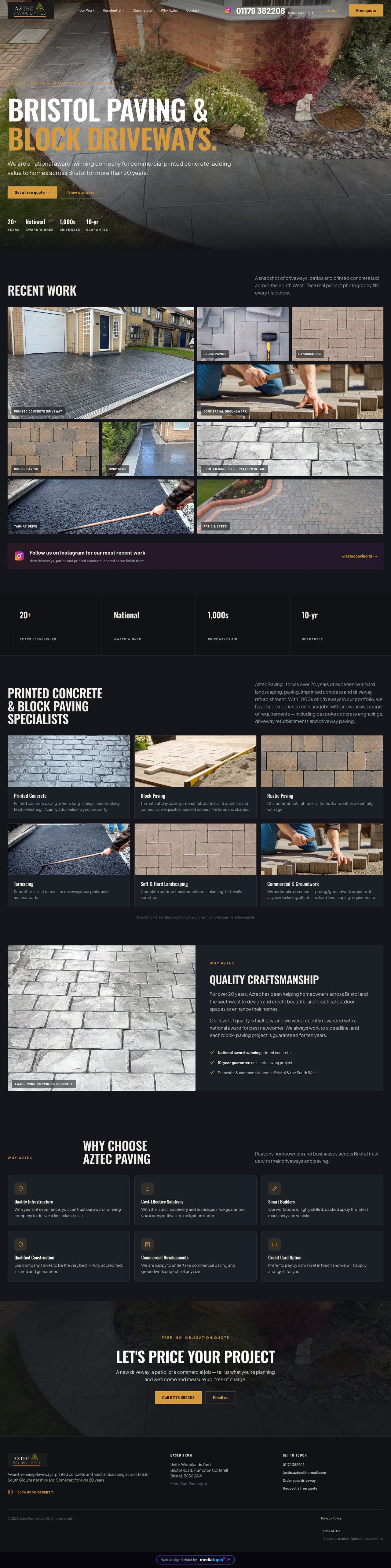
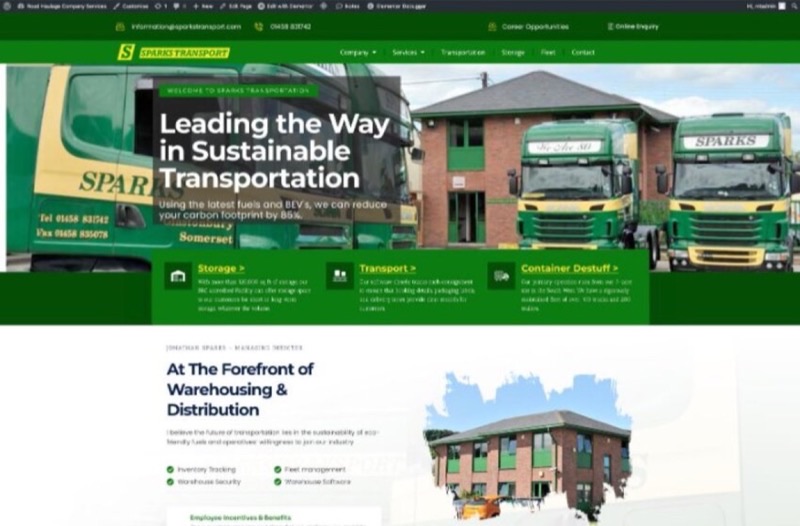
If you make something people buy on sight — signs, print, vehicle livery, shop fitting — and your website is not bringing the work in, that is exactly the job. The Sparks Transport case study and the Aztec Paving case study are comparable projects, both built around photography of the work.
What We Built
Project development work carried out
Seven Services, Seven Full Screens
The work photographed full-screen and swiped sideways by the scroll — no arrows, no autoplay, nothing to click through.
Every Page Given A Heading
One H1, a title and a description on all fourteen pages, plus the privacy, cookie and terms pages that used to 404.
A Photo Quote And A Chat
A photograph of the shopfront or the van — or the artwork they already have — reaches PJ Signs with a rough size attached.
Since 1986, Under One Roof
Design, manufacture and installation in Taunton, said plainly on the page, because it is the reason to ring them rather than a print portal.
Common Questions
Sign Company Website Design FAQs
More case studies
View all work →





Need a website for your sign business?
Tell me what you need and I will give you a fixed price. You deal with the person who builds it — not an account manager, not an offshore team.