- Brochure WebsitesProfessional 5-10 page sites
- Web Design PackagesMonthly plans from £69
- Responsive DesignFluid layouts for every device
- E-Commerce DesignStorefronts built to convert
- Product PagesCatalogue & product listings
- Mobile DesignMobile-first experiences
- Landing PagesHigh-converting campaign pages
- Website Redesign
- Case StudiesReal client projects
- Retail & E-CommerceOnline stores & shop websites
- Professional ServicesLaw, finance & consulting
- Hospitality & LeisureHotels, leisure & food service
- Property & LettingsEstate agents & lettings portals
- Trade & ConstructionBuilders, plumbers & electricians
- Industrial & ManufacturingEngineering, logistics & manufacturing
- Web ApplicationsCustom business tools & portals
- E-Commerce DevMagento, Shopify & bespoke
- CMS DevelopmentCustom content management
- Database SystemsBespoke data solutions
- Mobile AppsiOS, Android & hybrid
- Sage 50 IntegrationAutomate your accounts
- SaaS PlatformsMulti-tenant applications
- API DevelopmentRESTful & GraphQL APIs
- Next.js & ReactModern frontend frameworks
- WordPressBuild, fix, host & look after
- Search Engine MarketingRank higher on Google
- Content WritingSEO-optimised copy
- ConsultingStrategic digital advice
- Logo DesignBrand identity creation
- Web HostingDedicated UK servers
- Email HostingProfessional mailboxes
- MaintenanceOngoing support & updates
- Security & SSLKeep your site safe
- Domain RegistrationFind your perfect domain
- Blog & InsightsTips, guides & news
- Free SEO AuditCheck your site health
- AI ChatbotsGPT-powered conversational AI
- AI Voice AgentsAnswer calls 24/7 automatically
- AI AutomationEliminate repetitive workflows
- Custom AI DevelopmentTrained on your business data
- AI IntegrationConnect AI to your existing stack
- AI ConsultingStrategy & honest AI advice
- GPT-4 & ClaudeLatest large language models
- ElevenLabs VoiceNatural-sounding voice AI
- RAG SystemsAI that searches your knowledge base
- CRM IntegrationHubSpot, Salesforce & Pipedrive
- Document IntelligenceExtract data from any document
- Private AI DeploymentYour data never leaves your servers
Case Study
E-Scooter Workshop Website Design — Volt Bristol Case Study
Bristol’s e-scooter workshop — a sixteen-page site built from the owner’s own photographs, where a rider picks their scooter and the job and the message writes itself.

A workshop, not a shop
Volt Bristol repair, modify and service electric scooters from a unit on the Bristol Road in Whitchurch. They fit tyres, change and upgrade brakes, build batteries, sort wiring and lights, and they sell new scooters.
The first version of the site had an online shop and a trade login. Looking at it, the owner was clear that the workshop is the business and the shop is not, so it was rebuilt the same week as a workshop site: no basket, no login, the nine things the workshop does each on their own page, and a parts counter rather than a checkout. Trade accounts are shown honestly as coming soon, with a line to register interest.
Sixteen pages, and the design did not change — only what the site is for.
Pick your scooter, and the message writes itself
A rider with a problem does not want a contact form. They want to tell somebody what they are riding and what it is doing, and most of them are already on WhatsApp.
So the home page opens with a book-in tool. Pick your scooter, pick the job, and WhatsApp opens with the message already written — the model, the fault, and a request to book in. The workshop gets an enquiry that names the machine instead of one that says ‘hi, is anyone there’.
Underneath it, how a job actually goes, in the owner’s own words: message us, we find the fault — investigated methodically rather than replacing parts and hoping — then fixed and ready to roll.
A parts list that does not pretend
The parts counter lists what the workshop carries by size and type: tyres and tubes, pads and discs, lights, steering parts and electrics. What it does not do is quote a price or claim a part is on the shelf.
Only one tyre size had ever been posted as in stock, so every other row asks on WhatsApp instead of inventing a figure. A site that promises stock it has not got costs the workshop a phone call and a customer; one that says ‘ask’ costs it nothing. When the real list arrives, it drops straight in.
A photograph of the scooter, and a price
A snapped stem, a warning on the display, a tyre off the rim: all easier to show than to describe, particularly when the rider does not know what the part is called.
The corner of every page carries ‘Send a photo of your scooter’. The rider photographs the problem, says which scooter it is and what is happening, and it arrives with the picture attached. Beside it sits a chat that answers from the site’s own pages — which jobs they do, which scooters they work on, where the unit is, when they are open — and hands over to the enquiry form when somebody wants a person.
The workshop is open Tuesday to Saturday. Most riders find out something is broken on a Sunday.
Their own reviews, on every page
Fifty reviews on Google, every one of them five stars. That is the kind of thing a business leaves on Google and never mentions on its own website.
Here it sits in the corner of every page: the average, the count, and a link straight through to read them on Google. Nothing is retyped and nothing is selected — it is their own profile, shown where somebody is deciding whether to ring.
Built to be read, by Google and by an assistant
Every page states its own facts inside the markup it is served with: the workshop, the address, the opening hours, each service. That is what Google reads, and it is what the AI assistants people now ask read too, because they take the page as it arrives rather than waiting for scripts to run.
The photographs are the owner’s own, used with his permission — his shopfront lit up at night, his bench, the scooters he has actually worked on. The site went live on voltbristol.co.uk in September 2026.
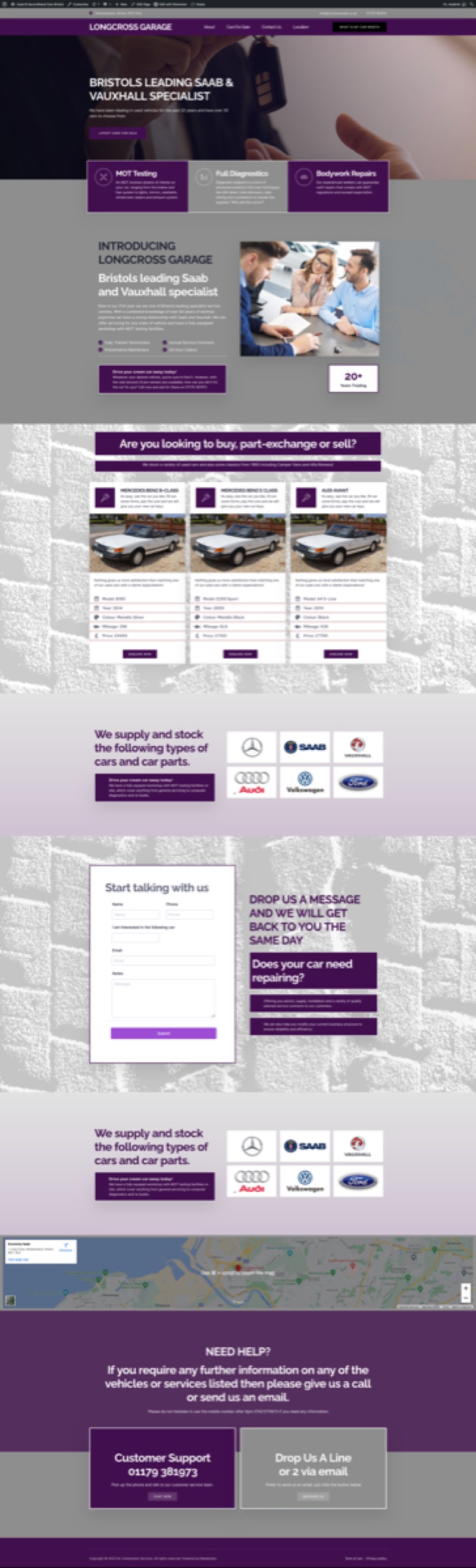
If you run a workshop and your website is not bringing jobs in, that is exactly the work. The AFB Motorcycles case study and the Longcross Garage case study are comparable projects.
What We Built
Project development work carried out
Sixteen Pages, Nine Services
Repairs, modifications, tyres, brake changes, brake upgrades, lights, battery builds, scooter sales and e-bikes, each on its own page.
Book In From The Home Page
Pick the scooter and the job, and WhatsApp opens with the message already written.
A Photo Quote And A Chat
A photograph of the fault reaches the workshop, and an assistant answers from their own pages when the unit is shut.
Fifty Five-Star Reviews
Their own Google profile shown in the corner of every page, with a link through to read all of them.
Common Questions
E-Scooter Workshop Website Design FAQs





Need a website for your workshop?
Tell me what you need and I will give you a fixed price. You deal with the person who builds it — not an account manager, not an offshore team.