- Brochure WebsitesProfessional 5-10 page sites
- Web Design PackagesMonthly plans from £69
- Responsive DesignFluid layouts for every device
- E-Commerce DesignStorefronts built to convert
- Product PagesCatalogue & product listings
- Mobile DesignMobile-first experiences
- Landing PagesHigh-converting campaign pages
- Website Redesign
- Case StudiesReal client projects
- Retail & E-CommerceOnline stores & shop websites
- Professional ServicesLaw, finance & consulting
- Hospitality & LeisureHotels, leisure & food service
- Property & LettingsEstate agents & lettings portals
- Trade & ConstructionBuilders, plumbers & electricians
- Industrial & ManufacturingEngineering, logistics & manufacturing
- Web ApplicationsCustom business tools & portals
- E-Commerce DevMagento, Shopify & bespoke
- CMS DevelopmentCustom content management
- Database SystemsBespoke data solutions
- Mobile AppsiOS, Android & hybrid
- Sage 50 IntegrationAutomate your accounts
- SaaS PlatformsMulti-tenant applications
- API DevelopmentRESTful & GraphQL APIs
- Next.js & ReactModern frontend frameworks
- WordPressBuild, fix, host & look after
- Search Engine MarketingRank higher on Google
- Content WritingSEO-optimised copy
- ConsultingStrategic digital advice
- Logo DesignBrand identity creation
- Web HostingDedicated UK servers
- Email HostingProfessional mailboxes
- MaintenanceOngoing support & updates
- Security & SSLKeep your site safe
- Domain RegistrationFind your perfect domain
- Blog & InsightsTips, guides & news
- Free SEO AuditCheck your site health
- AI ChatbotsGPT-powered conversational AI
- AI Voice AgentsAnswer calls 24/7 automatically
- AI AutomationEliminate repetitive workflows
- Custom AI DevelopmentTrained on your business data
- AI IntegrationConnect AI to your existing stack
- AI ConsultingStrategy & honest AI advice
- GPT-4 & ClaudeLatest large language models
- ElevenLabs VoiceNatural-sounding voice AI
- RAG SystemsAI that searches your knowledge base
- CRM IntegrationHubSpot, Salesforce & Pipedrive
- Document IntelligenceExtract data from any document
- Private AI DeploymentYour data never leaves your servers
Case Study
Review Request Software — Asking, and Actually Getting the Review
Most businesses never ask. This asks for them — one designed email to the customer while the job is still fresh, and the reviews it brings back go straight onto the website.
Almost nobody asks, and that is the whole problem
A happy customer will leave a review. They just will not think of it on their own, and by the evening the job is behind them and the moment has gone.
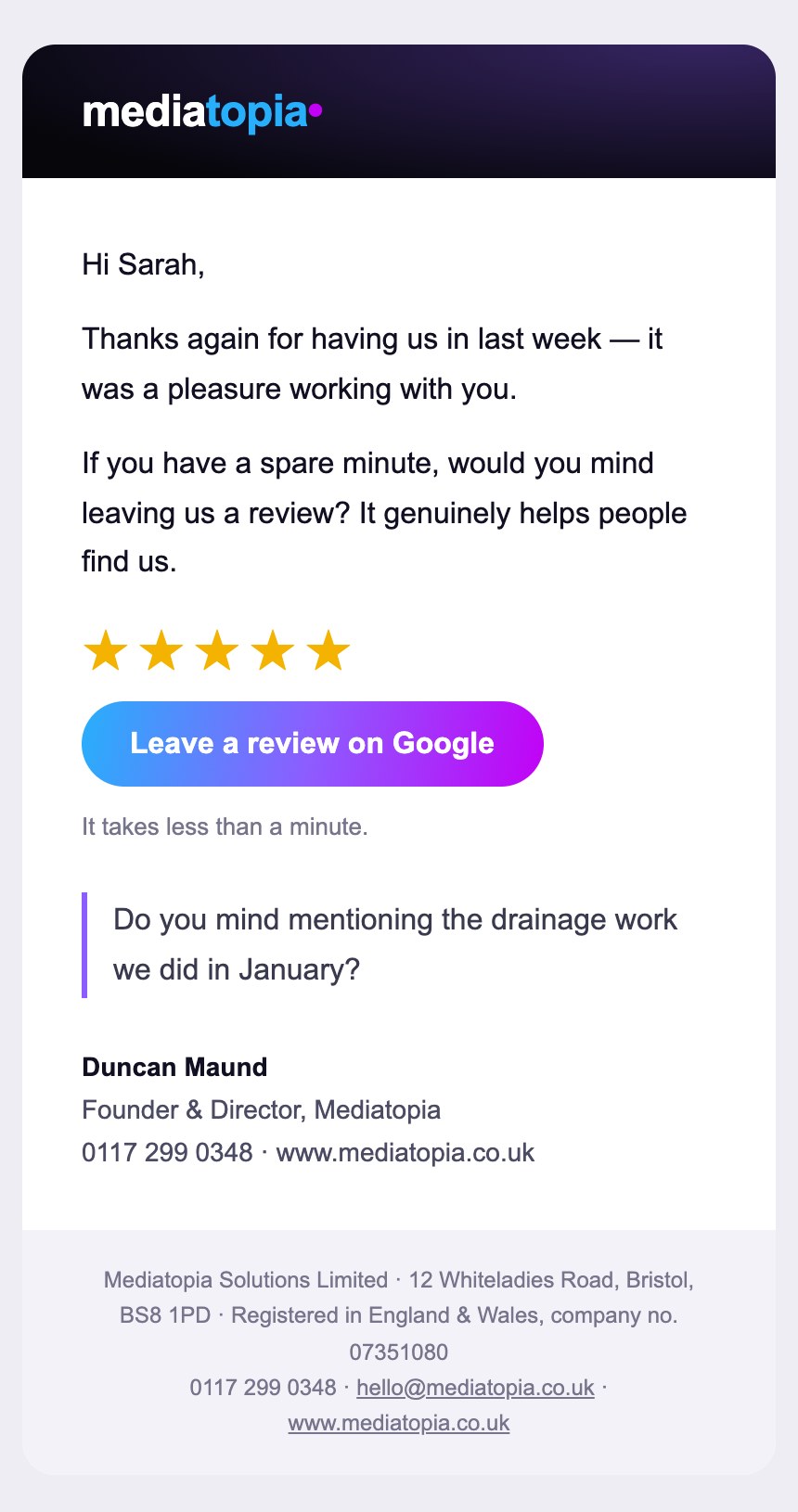
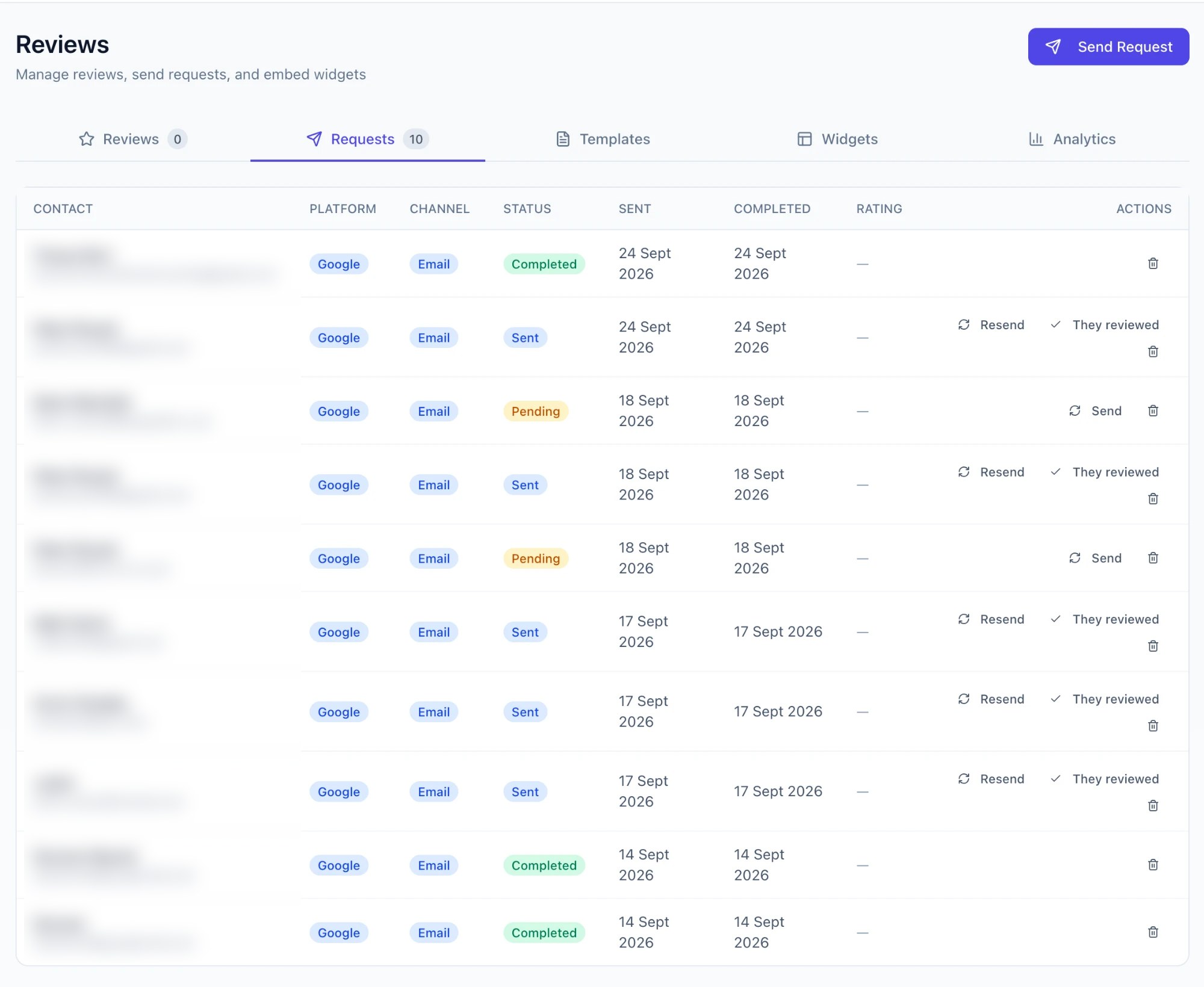
So the asking has to be the easy part. Pick the customer, pick where you want the review, press send. The email goes out written and designed, and the request is logged so you can see who has been asked, who has answered and who has not.
The email has to look like you, or it reads as spam
The first version of this went out as plain words — no logo, no signature. It did not work, and the reason was not subtle: it looked like every scam asking you to click something.
So the email is the business’s own. A wordmark at the top, a white card, one button, a signature and the company line at the foot. The signature and the company details are read from the business’s own settings, not typed into the email, so changing them in one place changes every request that goes out afterwards. A plain-text copy travels with it for mail apps that do not show HTML.
A line of your own goes above the signature — ‘do you mind mentioning the drainage work we did in January?’ — because a specific ask gets a specific review, and a template on its own reads as a mailshot.
Where UK customers actually leave reviews
Google, Facebook and Trustpilot are the obvious three. They are not the whole picture for a trade.
A plumber is reviewed on Checkatrade. A builder is on TrustATrader. Plenty of work comes through Yell and Bark. The screen used to offer Yelp — which barely exists in the UK — and none of those. It now offers nine places, including the four a British trade is actually judged on, and the same list is used everywhere the tool asks you where a review should go.
The reviews come back onto the website
A review sitting on Google does nothing for the page somebody is reading. The tool builds the HTML to put them on the site, so the reviews you collected show where a customer is deciding whether to ring.
Everything in that widget is escaped before it goes anywhere near a page. A review with an HTML tag in it once came out as code rather than words, and anything typed into a review would otherwise have run on the website showing it. It is a copy of the reviews as they stand, not a live feed, so nothing a stranger types can change a page on its own.
What it looks like in practice
The tool’s own record, since it went into use on 14 September 2026: ten requests sent, and the quickest review came back inside three minutes. The slowest of the answered ones was under the hour.
That is the difference between asking and hoping. The request goes while the customer still remembers the job, it takes them one tap, and the review is on the platform you chose rather than in a reply to an email that nobody else will ever read.
How you get it
You do not buy this on its own, and there is no monthly fee for it.
Mediatopia builds your website, and the website comes with a dashboard to run the business behind it — your enquiries, your customers, your documents, your marketing. Reviews is one screen on that dashboard. When we build the site, the tools come with it, set up with your own details and pointed at your own Google or Checkatrade page.
So the answer to ‘how do I get this?’ is: become a Mediatopia client. We design and build the website, and this is part of what you are running it with afterwards.
What that costs is on the pricing page, and you get a fixed price before any work starts.
Where it sits
Reviews is one screen of a wider system: the website, the enquiries it takes, the customers behind them and the marketing that goes back out. Asking for a review is not a separate app to log into — it is a button beside the customer who has just paid you.
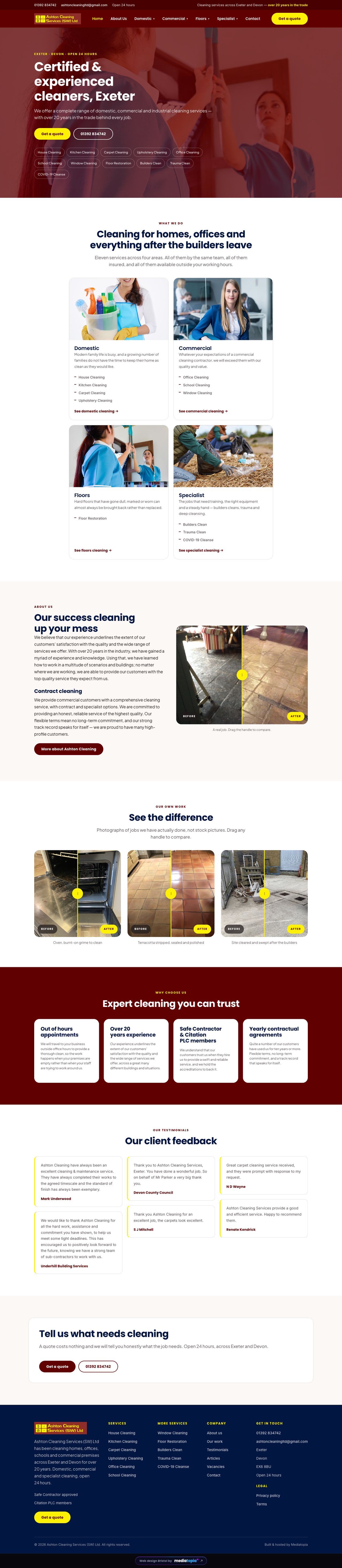
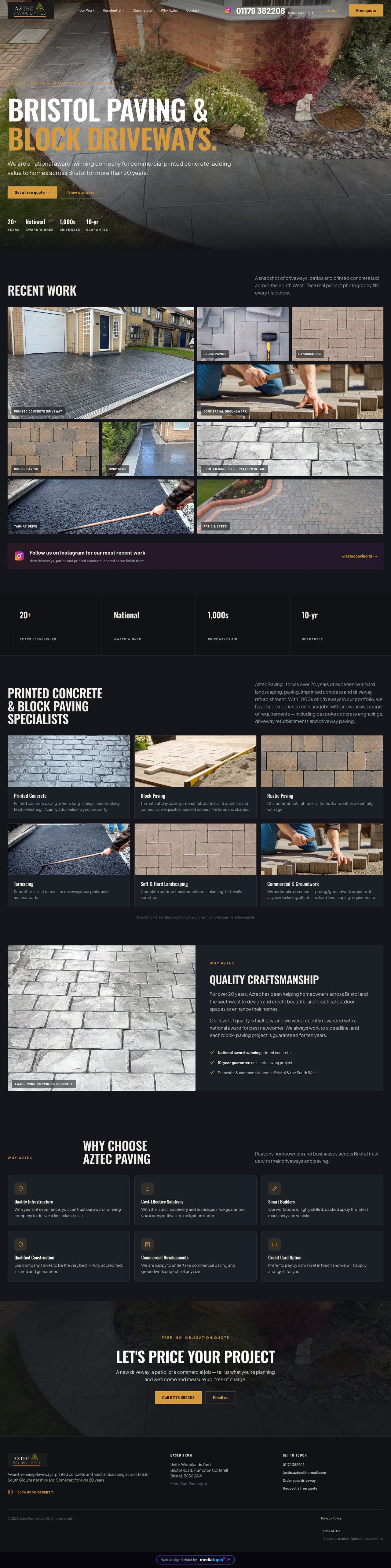
If you want a website that earns its keep rather than sits there, that is the same work as the Ashton Cleaning and Bristol Hydralifts projects.
What We Built
Project development work carried out
One-Press Requests
Pick the customer and the platform, press send. Who was asked, who answered and who has not is all on one screen.
An Email That Looks Like You
The wordmark, a signature and the company line, read from your own settings — not plain words that read as spam.
Nine Places A Review Can Go
Google, Facebook and Trustpilot, plus Checkatrade, Yell, Bark and TrustATrader — where UK trades are actually judged.
Reviews On Your Own Pages
The collected reviews render as HTML for the website, escaped, so nothing typed into a review can run on your site.
Common Questions
Review Request Software FAQs





This comes with a Mediatopia website
Mediatopia designs and builds your website, and the website comes with the dashboard that runs the business behind it. Reviews is one of the tools on it.